 The Fake Cadbury Christmas Promo Circulating on WhatsApp" loading="eager">
December brings lights, warm messages—and scams. Every holiday season, cybercriminals take advantage of the festive spirit to launch emotionally charged fraud campaigns. In 2025, one of the most active is the fake Cadbury Christmas promotion being spread via WhatsApp.
And this isn’t just a rumor—Which?, the well-known UK consumer protection agency, has officially warned about this scam, which offers free chocolate hampers in exchange for just a few clicks. At TecnetOne, we’ll tell you upfront: there are no free gifts—only a cleverly designed trap.
Why These Scams Work So Well During the Holidays
During this time of year, your guard is down. You’re more likely to believe in surprise gifts, seasonal deals, and messages forwarded by people you trust.
Scammers know this—and they tailor their campaigns accordingly.
WhatsApp is the perfect channel:
- Direct messages
- Familiar tone
- Fast spread
- Minimal visual verification
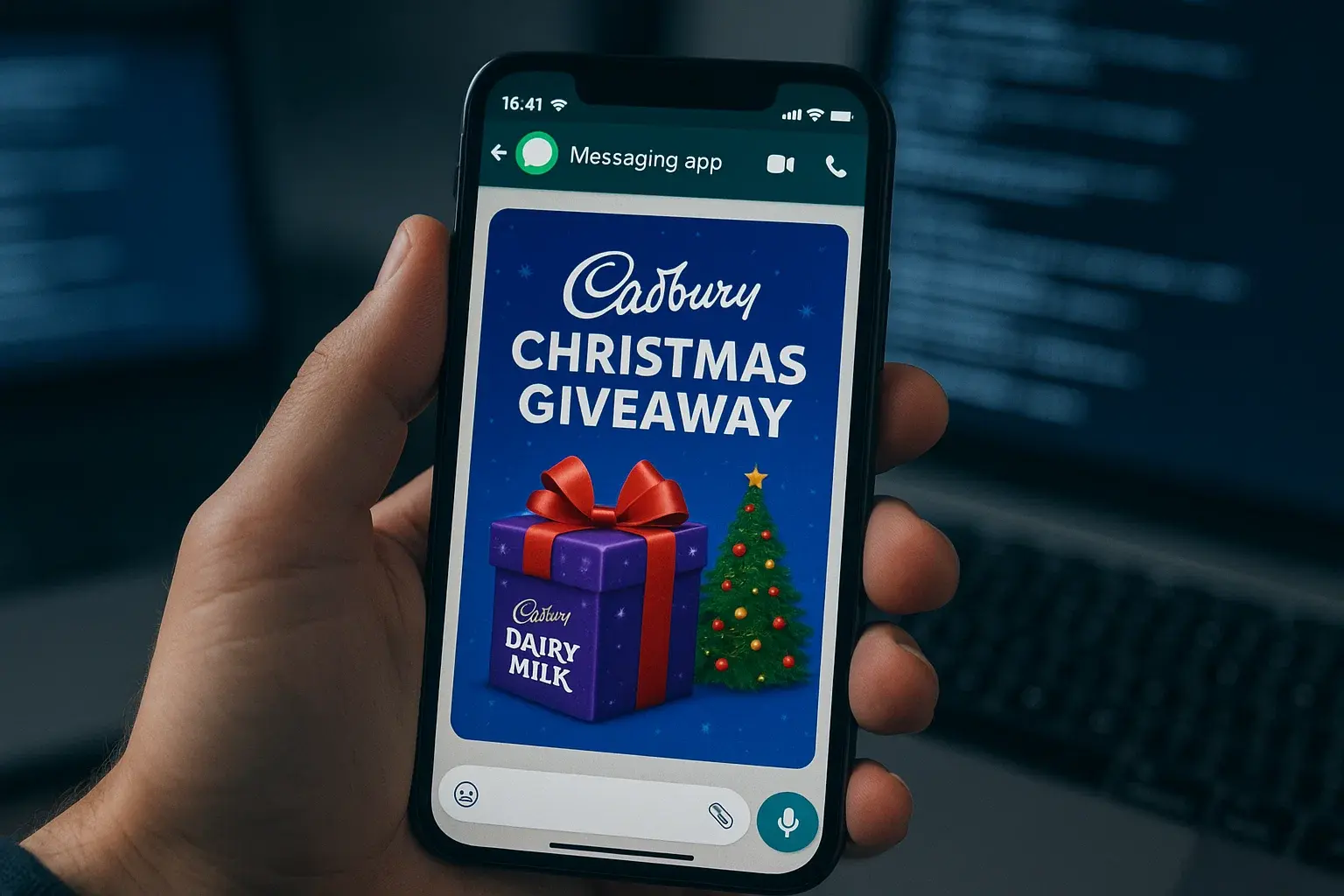
So when you see a message that says “Cadbury Christmas Giveaway” with festive colors and a link, your brain interprets it as an opportunity—not a threat.
Read more: Advertisements on WhatsApp: A risk to your privacy?
How the Cadbury WhatsApp Scam Works
There are several versions of the scam, but they all follow the same classic fraud pattern, just wrapped in holiday packaging.
Step 1: The Initial Message
You get a WhatsApp message claiming Cadbury is running a Christmas promo. It may mention:
- Chocolate gift baskets
- “Magic Chocolate Baskets”
- Exclusive seasonal giveaways
It usually includes logos, festive visuals, and sometimes even your name or city to make it feel personal.
Step 2: The Fake Link
The message contains a link that’s not Cadbury’s official domain, though it tries to look legit. Clicking it takes you to a fake website that seems “professional.”
That’s where the real fraud begins.
Step 3: The Fake Questionnaire
You’re asked to answer easy questions like:
- Do you like chocolate?
- Are you familiar with Cadbury?
- Do you buy Christmas gifts?
It doesn’t matter what you answer. The questions are just there to build trust and keep you engaged.
Step 4: The Gift Box Game
Next, you’re shown a game with multiple boxes. You lose once or twice, and then you “win.”
This is no accident—it’s designed to trigger excitement and make you feel close to getting your prize.
Step 5: The Real Goal—Sharing the Scam
To claim your prize, you’re asked to forward the message to multiple WhatsApp contacts or groups.
This is the crucial step for scammers:
- You become a distribution channel
- The scam spreads without ad costs
- It goes viral organically
Step 6: Data or Money Theft
Depending on the version, the scam ends with:
- Requests for personal data
- Asking for your email and phone number
- A small “shipping fee” payment
That “tiny fee” is enough to steal your card details. Needless to say, the chocolate never comes.
This Scam Looks Familiar—Because It Is
If this feels familiar, it’s because the Cadbury scam reuses a known playbook, just with new branding.
Recent examples include:
- Fake Sephora advent calendars
- Bogus supermarket gift cards
- Phony tech giveaways
Scammers don’t invent new methods—they recycle the same formula: new brand, new occasion, same scam.
Recognizing the pattern is one of your best defenses.
Red Flags to Watch For
At TecnetOne—and with analysis from security firms like Bitdefender—these are the signs of a scam:
- The link doesn’t match Cadbury’s official domains (like cadbury.co.uk)
- The promo arrives via WhatsApp unsolicited
- You’re pressured to share the message to “validate” your prize
- The offer seems too good to be true
- You’re asked to pay something to receive a “free” gift
If you see even one of these, don’t go any further.
What to Do If You Receive the Message
Even if it comes from a friend or family member, assume they were tricked too.
Take these steps:
- Don’t click the link
- Don’t share the message
- Delete it immediately
You can also report it directly on WhatsApp:
- Open the chat
- Tap the contact name
- Select Report and Block
This helps limit the spread.
You might also be interested in: WhatsApp launches Private Processing to Enable AI Features
Strengthen Your WhatsApp Security
While no security measure is 100% foolproof, you can lower your risk with one simple step: Enable two-step verification
In WhatsApp:
- Go to Settings
- Tap Account
- Select Two-step verification
- Create a six-digit PIN
- Add a recovery email
This protects your account even if someone tries to hijack it.
The Bigger Problem: Trust and Scam Automation
These scams don’t work only because people are gullible—they succeed because they:
- Leverage trusted brands
- Use automation tools
- Exploit trust between contacts
One fake promo can spread to thousands of people in minutes. And the more it’s shared “just in case,” the more believable it seems.
At TecnetOne, we emphasize a core idea: Cybersecurity is a social responsibility.
Not forwarding suspicious messages protects your data and your network.
Conclusion: The Best Gift Is a Healthy Dose of Skepticism
No major brand is giving away chocolate hampers through WhatsApp. They don’t run mass sweepstakes via private messages or ask you to forward links to win.
The Cadbury scam is just one of many—and it won’t be the last. The names, designs, and excuses will change. But the fraud behind them stays the same.
Next time you see a deal that looks too good to be true, remember: in cybersecurity, a little skepticism is self-care.
And that’s one of the best gifts you can give yourself this holiday season.