
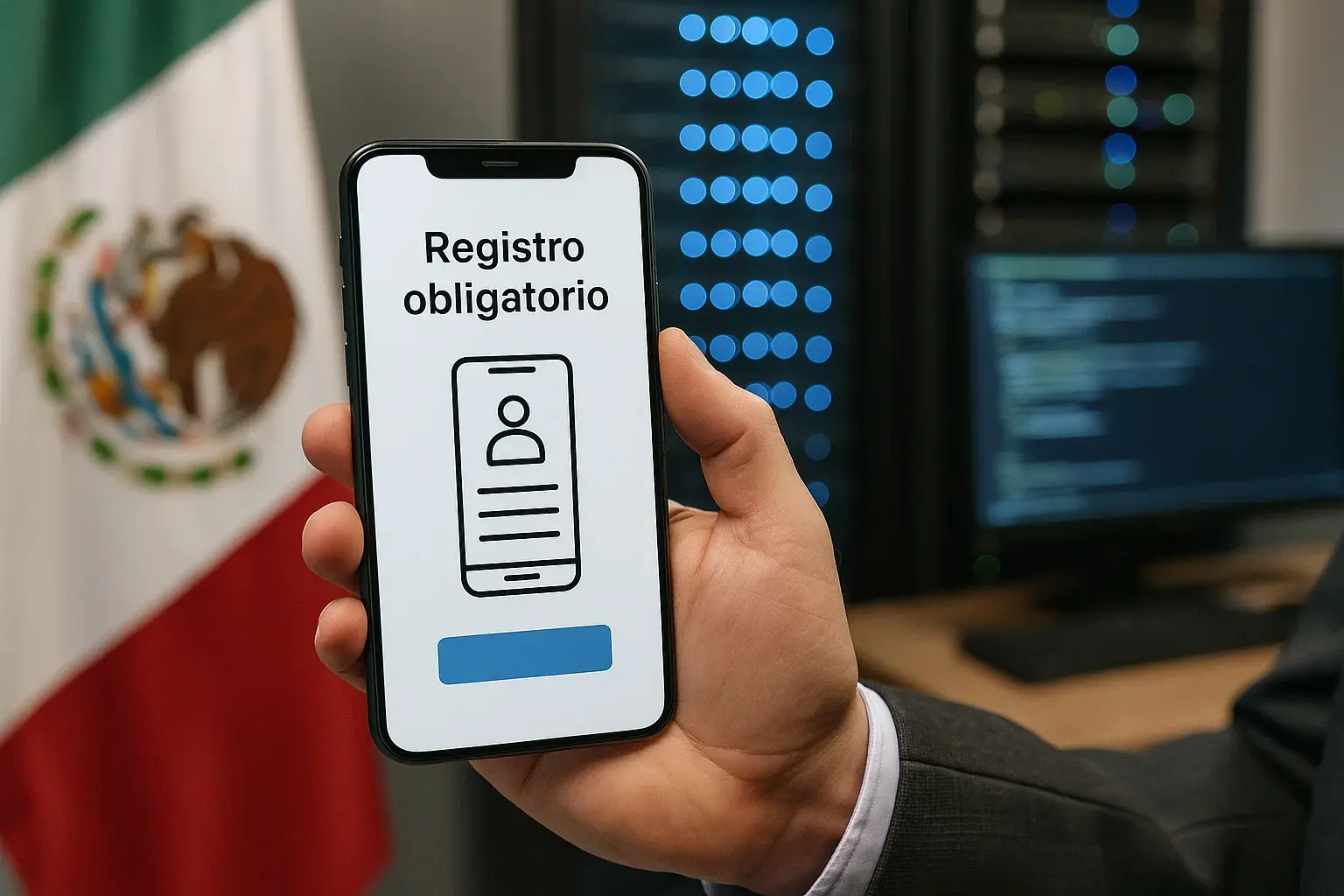
Starting January 9, 2026, Mexico will radically change the way you purchase and activate a mobile line. What you once could do without showing anything—not an ID, not proof of address, not even your CURP—will now be unthinkable. The new regulation requires all mobile lines, including prepaid, to be linked to an individual or legal entity through official documents.
In theory, the goal is to combat extortion, virtual kidnapping and phone fraud. But when you look at the full picture, what emerges is a much more complex scenario: a country where millions of personal records have already been leaked by the operators themselves, and where criminals moved long ago to tools this regulation does nothing to address.
At TecnetOne, we want to help you understand what this change really means and why, instead of solving a problem, it opens the door to others just as serious.
Goodbye Anonymous SIMs… and Welcome to a New Layer of Surveillance
For decades, Mexico was one of the few countries where you could buy a SIM card anywhere and activate it without providing any personal information. That practice certainly fueled a market for disposable lines—but it also protected your privacy in an environment full of data breaches.
With the new CRT rules, that anonymity disappears. To activate any line you must provide:
- Official identification
- CURP
- RFC (for businesses)
Existing lines must be regularized before June 2026 or they will be suspended. No exceptions.
In theory, it’s a security measure. In practice, it’s the creation of a distributed registry of personal information managed by private companies with a worrying security history.
The Government Promises Security… but Hands Responsibility to Companies That Have Already Failed
The CRT argues that operators—Telcel, AT&T, Movistar and others—will handle data under the same standards used for postpaid clients. But here’s the real problem:
In 2025, both AT&T and Telmex suffered massive data breaches.
Millions of records were exposed:
- Addresses
- CURP
- Financial information
- Consumption history
- Phone numbers
- Billing data
And now these same actors will store your ID, your CURP and the details of your active lines.
The government? It washes its hands. Responsibility falls exclusively on the operators.
If another breach occurs—and we know it’s only a matter of time—the consequences may include:
- Financial fraud
- Identity theft
- New lines activated under your name
- Targeted extortion
- Digital impersonation
Exactly what this regulation claims it aims to prevent.
The Ghost of PANAUT Returns—Just in Disguise
In 2021, the government attempted to implement PANAUT, the National Mobile User Registry. It required biometric data and a central database controlled by the state. The Supreme Court struck it down as invasive and dangerous.
The new guidelines claim to avoid that approach:
- No biometrics
- No centralized government registry
- Data stored by operators
But that doesn’t eliminate the risk— it only privatizes it. Instead of your data being exposed by a government error, you now rely on private companies that have repeatedly failed to protect far less sensitive data.
And if a hacker breaches an operator’s database, they gain not only your number—but your complete identity.
The Registration Won’t Stop Extortion—Because Extortion No Longer Depends on Mexican SIMs
Here’s the truth few are talking about: extortion no longer relies on Mexican phone numbers.
Criminals moved years ago to:
- VoIP services
- International numbers that look local
- Messaging apps like WhatsApp, Telegram or Skype
- Questionable VPNs
- Ephemeral accounts that rotate every 24 hours
- Spoofed caller Ids
You can register every SIM in the country and still not impact the real communication infrastructure criminals use.
Extortion calls will continue.
Fraud will continue.
Impersonation will increase.
Only legitimate users will lose privacy and peace of mind.
The Next Big Threat: Identity Theft Driven by SIM Registration
The government says operators will validate your documents against official databases. But identity theft in Mexico is completely out of control, and the black market for personal documents is enormous.
This means criminals can:
- Purchase leaked copies of your INE, CURP or RFC
- Register a SIM under your name
- Use it for crimes
- Vanish
And you only find out when:
- You try to open a service and get denied
- You receive suspicious charges or notifications
- The district attorney calls because your name appears linked to a criminal line
By then, proving it wasn’t you is a long, frustrating process.
Similar titles: Coatlicue: Supercomputer Without Digital Foundations in Mexico
Security or Illusion? The Measure Leaves the Real Criminal Ecosystem Untouched
Although it sounds like progress, the measure ignores the fundamental elements of criminal communication in Mexico:
- It doesn’t regulate VoIP
- It doesn’t block spoofed foreign numbers
- It doesn’t stop caller ID manipulation
- It doesn’t involve advanced digital monitoring
- It doesn’t cut extortion routes operating from abroad
- It doesn’t require platforms like WhatsApp to ensure identity verification
It’s a policy designed for the Mexico of 2008—not for the Mexico of 2026.
Between Security and Privacy, the User Gets Caught in the Middle
The CRT insists this registration will “restore trust” in mobile telephony. But trust isn’t declared—it’s earned.
And it’s earned by proving you can protect the data you now force users to hand over.
Today, millions will have to provide sensitive information to companies with a fragile security record—getting in return a promise that doesn’t address the real problem.
At TecnetOne, we see it clearly: If the government wants to talk about security, it must first talk about cybersecurity. Without trustworthy operators, there will be no safe registration system.
Conclusion: A Policy That Controls More but Protects Little
The mandatory SIM registration arrives as a risky bet where you give more information yet receive very little protection.
Yes, phone anonymity disappears.
Yes, traceability improves—on paper.
But the crimes this policy aims to eliminate no longer rely on the infrastructure it seeks to control.
Meanwhile, you hand your data to a sector with a fragile track record, in a country that breaks its own leak records every year.
At TecnetOne, we believe the real conversation should start elsewhere: strengthening cybersecurity for those who will guard this information and protecting citizens in a criminal ecosystem that evolves faster than regulation.
Until that happens, the mandatory registry will remain just that: mandatory, not necessarily secure.