 Copilot Reprompt Flaw: How One Click Was Enough to Leak Data" loading="eager">
If you work in an office or use Windows daily, chances are Copilot has already become part of your routine—even if not always by choice. For many users, Copilot has gone from a promise of productivity to an omnipresent tool that causes a certain level of fatigue. And, as often happens when a technology is rolled out quickly and at massive scale, security ends up paying part of the price.
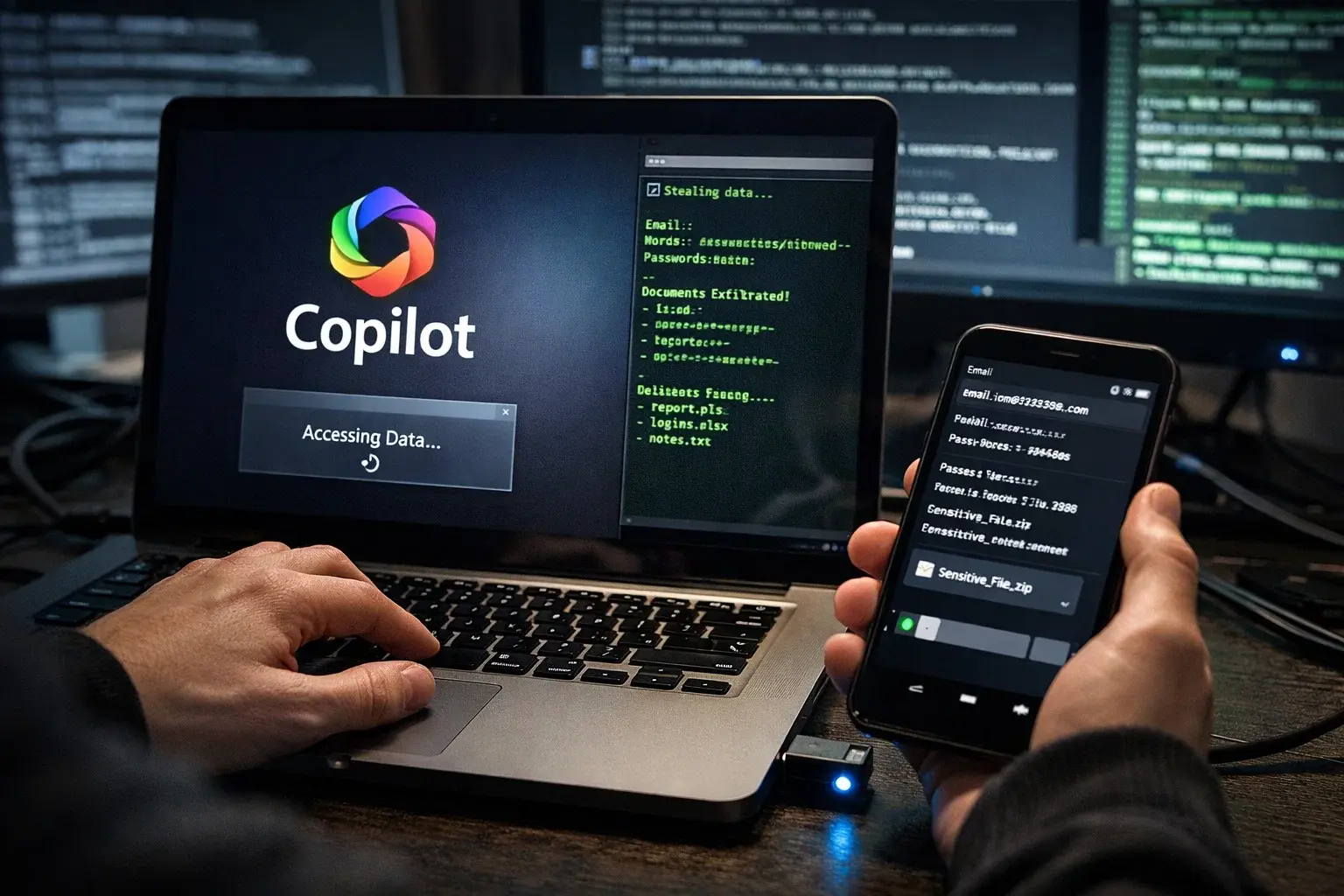
That is exactly what happened with Reprompt, a now‑patched vulnerability that allowed user data to be exfiltrated with a single click on a link. Yes, one click. No pop‑ups, no permission prompts, no clear warnings. And that is precisely what makes this flaw so unsettling.
At TecnetOne, we want to explain what happened, why this exploit was so dangerous, and what lessons you should take away if you use Copilot—or any AI‑based assistant.
A Difficult Moment for Copilot and Microsoft
Copilot does not arrive at this incident during its best reputational moment. While Microsoft and OpenAI try to position it as the ultimate assistant, Google achieved something unthinkable just a year ago: convincing Apple to integrate Gemini instead of ChatGPT for Apple Intelligence. A direct hit in the race to dominate consumer AI.
At the same time, Copilot has become mandatory for many users, increasing the pressure on Microsoft. The more widely a tool is used, the more attractive it becomes as a target.
That is where Reprompt comes in.
What Exactly Was the “Reprompt” Exploit?
The attack, discovered by Varonis Threat Labs, was named Reprompt and exploited an apparently harmless Copilot feature: the ability to pass prompts through a URL using the q parameter.
This mechanism is not new. You have seen it countless times:
- You search something on Google and the query appears in the URL
- You open a tool and the text field is automatically prefilled
Copilot worked the same way—and that was the problem.
An attacker could inject malicious instructions directly into the URL, disguised as a normal query. When you clicked that link, Copilot processed the content as if you had typed it yourself.
From there, things could quickly spiral out of control.
Read more: How does Microsoft Copilot work in Azure?
A One‑Click Exploit (and Why That Changes Everything)
What made Reprompt especially serious was not just the technique, but the level of user interaction required. In many attacks, you still need to:
- Download something
- Accept permissions
- Confirm suspicious actions
Here, none of that was necessary.
With Reprompt, simply opening a link was enough. The rest happened automatically. From the user’s perspective, nothing unusual occurred. From the attacker’s perspective, Copilot had started working on their behalf.
This type of exploit is particularly dangerous because it:
- Scales easily
- Fits perfectly into phishing campaigns
- Raises no immediate red flags
The Techniques Behind Reprompt (Without the Jargon)
Varonis documented a surprisingly elegant—and worrying—attack chain based on several combined techniques:
- Parameter‑to‑Prompt (P2P)
The attacker used the q URL parameter to inject instructions that Copilot interpreted as legitimate prompts.
- Double‑request
Some protections worked only on the first request. The exploit forced a second request to bypass those safeguards.
- Chain‑request
Copilot could receive additional instructions from an attacker‑controlled server, allowing silent and continuous data exfiltration.
Put simply: Copilot could be guided step by step to collect contextual user information and send it out—without you noticing.
What Kind of Data Could Be Stolen?
According to the researchers, the attack could attempt to access information available in Copilot’s context, such as:
- Recent interaction history
- Viewed or generated content
- Account‑related and connected service information
- Metadata like approximate location or usage patterns
This did not necessarily mean “stealing all your files,” but it was enough data to profile the user, understand their environment, and prepare far more targeted follow‑up attacks.
Who Was Actually Affected by Reprompt?
This distinction is critical.
According to the published information:
- Reprompt affected Copilot Personal
- It did not impact Microsoft 365 Copilot, the enterprise version
This is not accidental. Corporate environments typically include:
- Stronger administrative controls
- Auditing
- DLP policies
- Context restrictions
Still, the case highlights a key issue: AI security is not uniform, and consumer versions can easily become the weakest link.
Microsoft’s Response (and the Timeline)
Microsoft was notified by Varonis in late August 2025. The fix was finally released on January 13, 2026, as part of Patch Tuesday.
From a responsible disclosure perspective, the process was correct:
- Private disclosure
- Investigation
- Patch development
- Public disclosure after remediation
But it also leaves an uncomfortable thought: that door remained open for months.
You might also be interested in: Microsoft 365 Copilot: New Design and New Features
The Real Issue Isn’t Reprompt—It’s AI That “Does Things”
This is where the discussion becomes more interesting.
Reprompt is fixed, but the structural issue remains. Copilot—and any modern AI assistant—is useful because it:
- Has context
- Accesses services
- Interacts with real data
And that is exactly why the attack surface expands.
Every new capability introduces:
- New flows
- New integrations
- New ways to manipulate the model
In short: an AI that does nothing is safe—but useless. An AI that does things is powerful—and dangerous if not designed with security from the start.
What You Can Learn from This Incident
Even if you are not a researcher or a security professional, there are clear takeaways:
- Be suspicious of “smart” links
If a link opens a tool with prefilled text, be cautious—especially if it comes via email or messaging apps. - Do not underestimate AI assistants
They are not just chatbots; they are interfaces with access to real data and services. - Keep everything updated
In this case, the patch closed the hole—but only if you installed it. - Personal versions matter too
Risk does not live only in enterprises. Individual users remain valuable targets.
Conclusion: Reprompt Is a Warning, Not an Exception
The Reprompt flaw in Copilot is not an isolated anecdote. It is a clear signal of the types of risks that come with the mass adoption of artificial intelligence.
At TecnetOne, we believe the solution is not rejecting these tools, but:
- Understanding how they work
- Demanding security by design
- Using them with awareness and judgment
AI is here to stay. But cases like this show that every gain in convenience must be matched by an equal gain in security. Because when a single click is enough, the margin for error becomes dangerously small.