
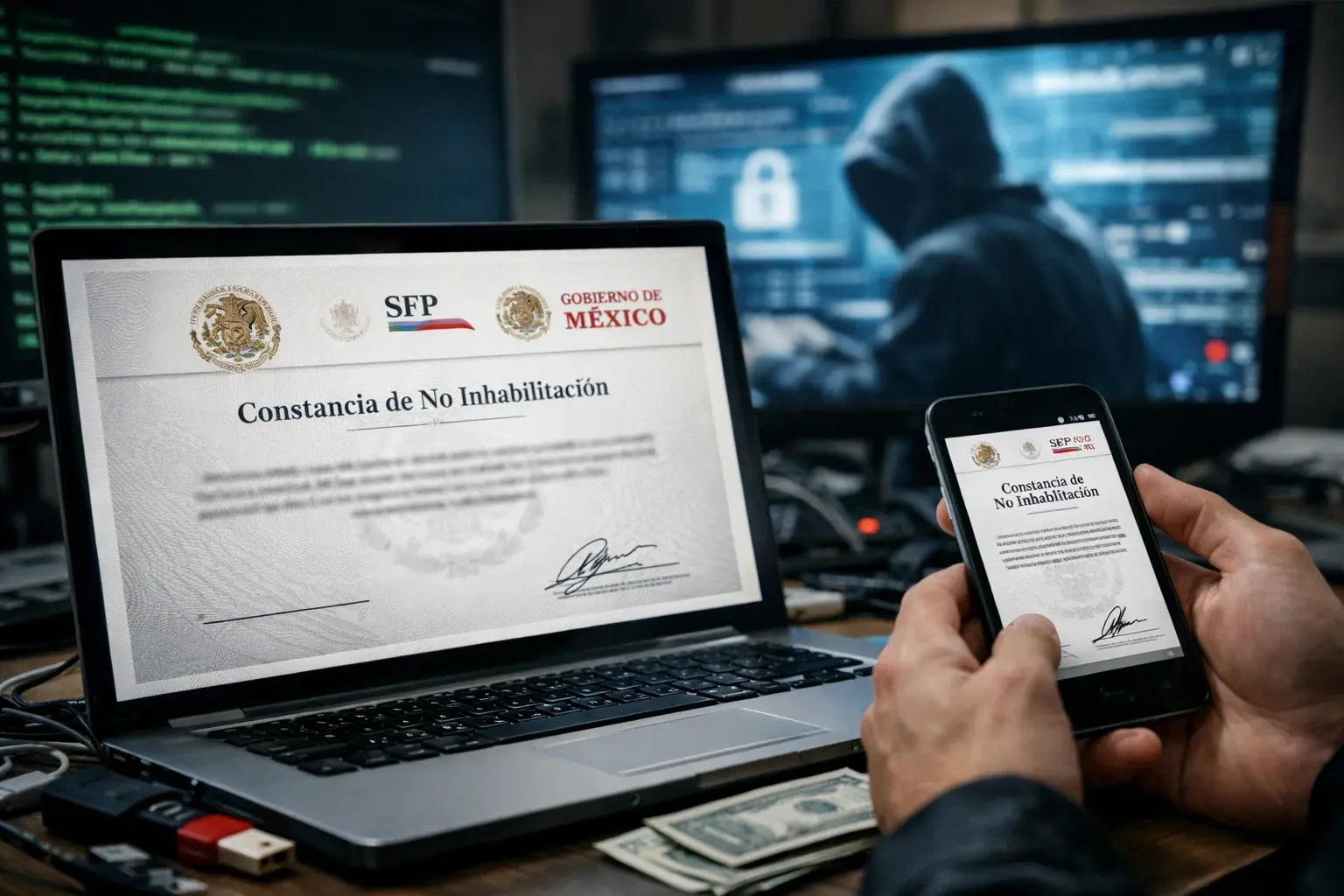
Imagine you urgently need a Certificate of No Disqualification for a job application or an administrative process. You search online, land on what looks like an official website, see logos from the Government of Mexico, names of public agencies, and a form promising to solve everything in minutes. You trust it, enter your details—and without realizing it, you’ve fallen into a digital scam.
This is not a hypothetical scenario. It’s exactly what is happening in Mexico and why the Secretariat of Anti-Corruption and Good Governance has issued a public warning. At TecnetOne, we explain what’s going on, how these frauds operate, and—most importantly—how to protect yourself.
A Fake Website Impersonating the Government
Authorities detected a fraudulent website impersonating official Government of Mexico portals to offer fake administrative procedures, particularly the issuance of Certificates of No Disqualification. The goal is clear: defraud citizens and harvest personal data.
The alert was triggered after several people contacted official agencies to report irregularities in certificates supposedly issued through this site. Upon review, officials confirmed the documents had no legal validity and that the website is not linked to any government institution.
Visual Cloning: The Scam’s Main Weapon
One of the most dangerous aspects of this fraud is how convincing it looks. The fake site:
- Uses official Government of Mexico logos
- References real agencies, such as the now-defunct Ministry of Public Administration
- Mimics colors, fonts, and layouts from legitimate government portals
At first glance, everything appears authentic—and that’s precisely the problem. Cybercriminals no longer rely on poorly written emails or crude websites. They now clone institutional branding to create instant trust.
Learn more: Is the Mexican Government Being Hacked by Its Own Employees?
Why Is This Type of Fraud So Effective?
Because it exploits several factors at once:
- Urgency
Many people need these certificates quickly for jobs, promotions, or administrative requirements. Stress reduces verification. - Authority
Official seals and agency names lower your guard automatically. - Accelerated digitalization
More government services are moving online—good news, but also an opportunity for criminals to blend in. - Lack of technical knowledge
Not everyone knows how to identify an official domain or spot a fraudulent website.
The Risk Goes Beyond Money
While some of these sites charge for fake procedures, the real danger lies in the data you provide. You may be handing over:
- Full name
- CURP (Mexican personal ID code)
- Employment details
- Contact information
- In some cases, official documents
This data can later be used for identity theft, more sophisticated fraud schemes, or sold on illegal markets.
At TecnetOne, we emphasize that these scams are not isolated incidents—they’re part of an increasingly sophisticated social engineering ecosystem.
The Golden Rule: Official Sites End in .gob.mx
The Secretariat of Anti-Corruption and Good Governance was very clear:
All official Government of Mexico websites end in “.gob.mx”.
If a site offering a government procedure:
- Does not end in .gob.mx
- Uses strange name variations
- Includes terms like “official,” “mx-gob,” or “tramites-gob”
You should immediately distrust it.
The agency also reminded citizens that only its official portal is valid for obtaining certificates related to:
- Disqualification
- No disqualification
- Sanctions
- No record of sanctions
Any other site offering these documents is committing fraud.
How to Spot a Fake Portal Step by Step
To avoid falling for these scams, follow these practical tips:
- Inspect the domain carefully
Don’t trust the design alone—check the full URL in the address bar. - Be suspicious of “express” procedures
Promises of instant results with no verification are a red flag. - Avoid suspicious ads and links
Many fake sites are promoted via misleading ads or social media posts. - Verify through official sources
Always start from the official government website. - Don’t share data if something feels off
No procedure is worth risking your identity.
What If You Already Entered or Shared Information?
If you believe you interacted with a fake site:
- Change passwords linked to your email and accounts
- Monitor for misuse of your personal information
- Report the site to the relevant authorities
- Avoid entering data on unverified portals again
The sooner you act, the lower the potential damage.
Similar titles: Hacker AKA_Astaroth Exposes Official Data from Colima and More
Authorities and Citizens: Shared Responsibility
This case shows that even when authorities respond and issue alerts, you remain the first line of defense. Cybersecurity is no longer just a technical issue—it’s about digital habits.
At TecnetOne, we often see that the most successful scams don’t exploit technical vulnerabilities, but rather trust and urgency.
A Growing Trend: Institutional Impersonation
Impersonating government portals is not new—but it’s growing fast. Cybercriminals know that:
- Digital government services will keep expanding
- Citizens trust online procedures
- Official visual identities are highly effective
This likely won’t be the last scam of its kind.
Conclusion: Verifying Means Protecting Yourself
The alert about fake certificates is a powerful reminder: not everything that looks official truly is. In an information-saturated digital world, taking a few minutes to verify a site can save you months of trouble.
Remember:
- .gob.mx domain—or nothing
- No official procedure is done through “alternative” sites
- Your personal data is valuable
At TecnetOne, we recommend a simple rule for any digital procedure: If you can’t verify it 100%, don’t do it.
Prevention, once again, remains the best defense against digital fraud.
