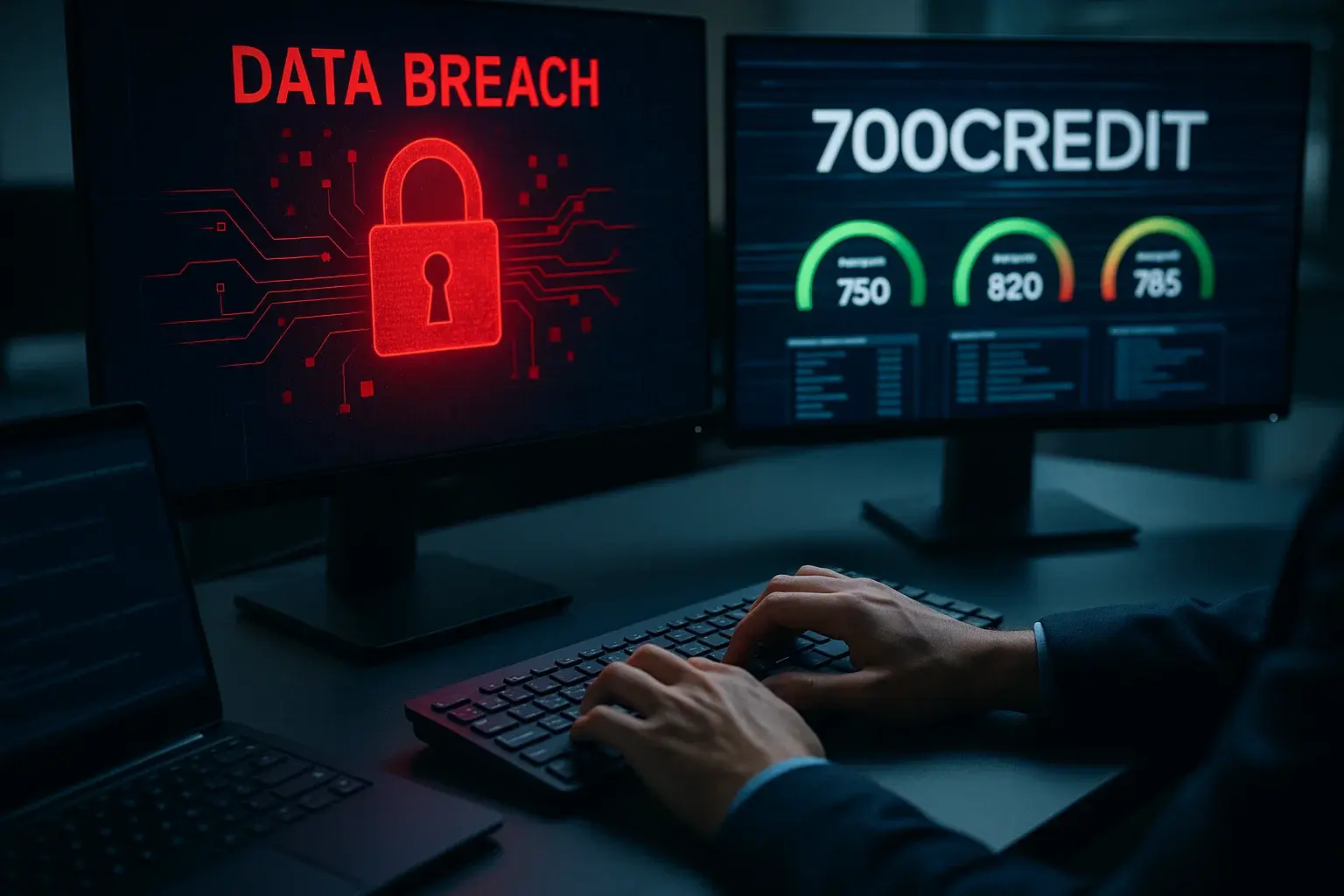
 700Credit Data Breach: When Your Financial Information Gets Exposed" loading="eager">
If you’ve ever applied for financing to buy a car, motorcycle, or RV in the U.S., chances are your data went through third-party tech providers you've never heard of. One of them is 700Credit, a fintech company now at the center of one of 2025’s most sensitive data breaches.
The company confirmed a security breach affecting at least 5.6 million individuals, exposing extremely sensitive data. At TecnetOne, we see this as a clear warning: just because you’ve never dealt with a company directly doesn’t mean your data isn’t in their hands.
Who Is 700Credit and Why Do They Handle So Much Data?
700Credit is a Michigan-based financial services and data provider. They don’t sell credit directly to consumers — they provide critical data to dealerships selling:
- Cars
- RVs
- Boats
- Powersports vehicles
Their services include:
- Credit reports
- Prequalification checks (“soft pulls”)
- Identity verification
- Fraud detection
- Regulatory compliance tools
They integrate directly with 18,000+ dealerships across the U.S., giving them access to millions of consumer records — even from people who’ve never heard of them.
What Happened in the Data Breach?
The breach occurred in October 2025, but the data stolen was collected between May and October. During that time, malicious actors gained unauthorized access to personal data stored on the platform.
Exposed data includes:
- Full names
- Addresses
- Date of birth
- Social Security Numbers (SSNs)
That last item makes this a high-impact breach, as SSNs are among the most powerful tools for identity theft and fraud.
700Credit publicly confirmed the breach and acknowledged it as another major hit against their industry.
Learn more: Salesforce Data Breach Hits Google, Adidas, Chanel, and More
How the Company Responded
In their official statement, 700Credit said:
- The attack was limited to the application layer
- No impact on internal networks or core operations
- So far, no evidence of identity theft or fraud linked to the breach
Their response included:
- Reporting to the FBI and FTC
- Handling regulatory notifications on behalf of dealerships
- Alerting state attorneys general
- Offering credit monitoring services to affected consumers
At TecnetOne, we believe these are necessary steps — but they don’t eliminate long-term risks once sensitive data escapes organizational control.
Michigan’s Attorney General Issues Warning
Michigan AG Dana Nessel issued a new consumer alert after confirming that over 160,000 residents were affected.
Her recommendations:
- Freeze your credit
- Use monitoring services
- Watch for fraud attempts
These warnings are not overreactions — when SSNs are leaked, the consequences can emerge months or even years later.
Why This Type of Breach Is Uniquely Dangerous
Unlike an email or password, you can’t change your birth date or Social Security Number. That makes this breach a permanent threat.
Stolen SSNs can be used to:
- Open loans or credit in your name
- File fake tax returns
- Access financial services
- Launch highly convincing social engineering attacks
And this type of data often ends up in underground markets, sold repeatedly over time.
From our TecnetOne perspective, the real danger isn’t just this one attack — it’s the growing concentration of sensitive data in third-party platforms far removed from user awareness.
Similar titles: Google Hit by Data Breach Following Salesforce Attacks
What You Should Do If You Might Be Affected
Even if you haven’t been notified yet, here’s what you can do now:
- Check your credit reports regularly
In the U.S., you get free weekly access to reports from Equifax, Experian, and TransUnion
- Consider freezing your credit
Prevents accounts from being opened in your name
- Enable multi-factor authentication (MFA)
Especially on financial, email, and critical accounts
- Be suspicious of unknown messages or calls
Many attacks following breaches use highly personalized phishing
- Share less data
Delete old accounts and remove unnecessary info from platforms
Lessons for Businesses and Individuals
This case reinforces critical lessons:
- You don’t need to be a direct customer for your data to be compromised
- Application-layer attacks are rising
- Your digital trust chain is only as strong as its weakest link
For companies:
- Limit the amount of data collected
- Segment system access
- Monitor continuously
- Accept that breaches are a matter of time, not possibility
For users:
Your identity protection is no longer optional.
Conclusion: A Breach Isn’t Over Just Because It’s Public
700Credit says there’s no evidence of fraud so far — but that doesn’t mean the risk is gone. With leaks of this magnitude, the real damage often comes later.
Modern digital security isn’t just about reacting to incidents. It’s about living in proactive mode every day.
If your financial data is handled by companies you don’t even know, protecting your identity is no longer someone else’s job — it’s yours.

Gustavo Sánchez
Microsoft Cloud and Cybersecurity expert with more than a decade of experience in the technology industry. He is recognized for his extensive knowledge in implementing cloud-based solutions and protecting data and systems against cyber threats. As a leader and speaker, Gustavo continues to share his knowledge and best practices at technology events and training programs.