In many businesses, it's necessary to offer services accessible from the Internet, such as a website, email, or corporate applications. These services can be hosted in the cloud or managed internally—an option that allows greater control over information and an infrastructure tailored to the needs of the business.
To prevent this exposure from putting the internal network at risk, the DMZ (Demilitarized Zone) comes into play—a key architecture within perimeter security that isolates public-facing services and significantly reduces the impact of potential attacks.
Table of Contents
- What Is a DMZ (Demilitarized Zone)?
- What Is a DMZ Used For?
- How Does a DMZ Work?
- Benefits of Implementing a DMZ
- DMZ Design and Architecture
- Importance of DMZ Networks
What Is a DMZ (Demilitarized Zone)?
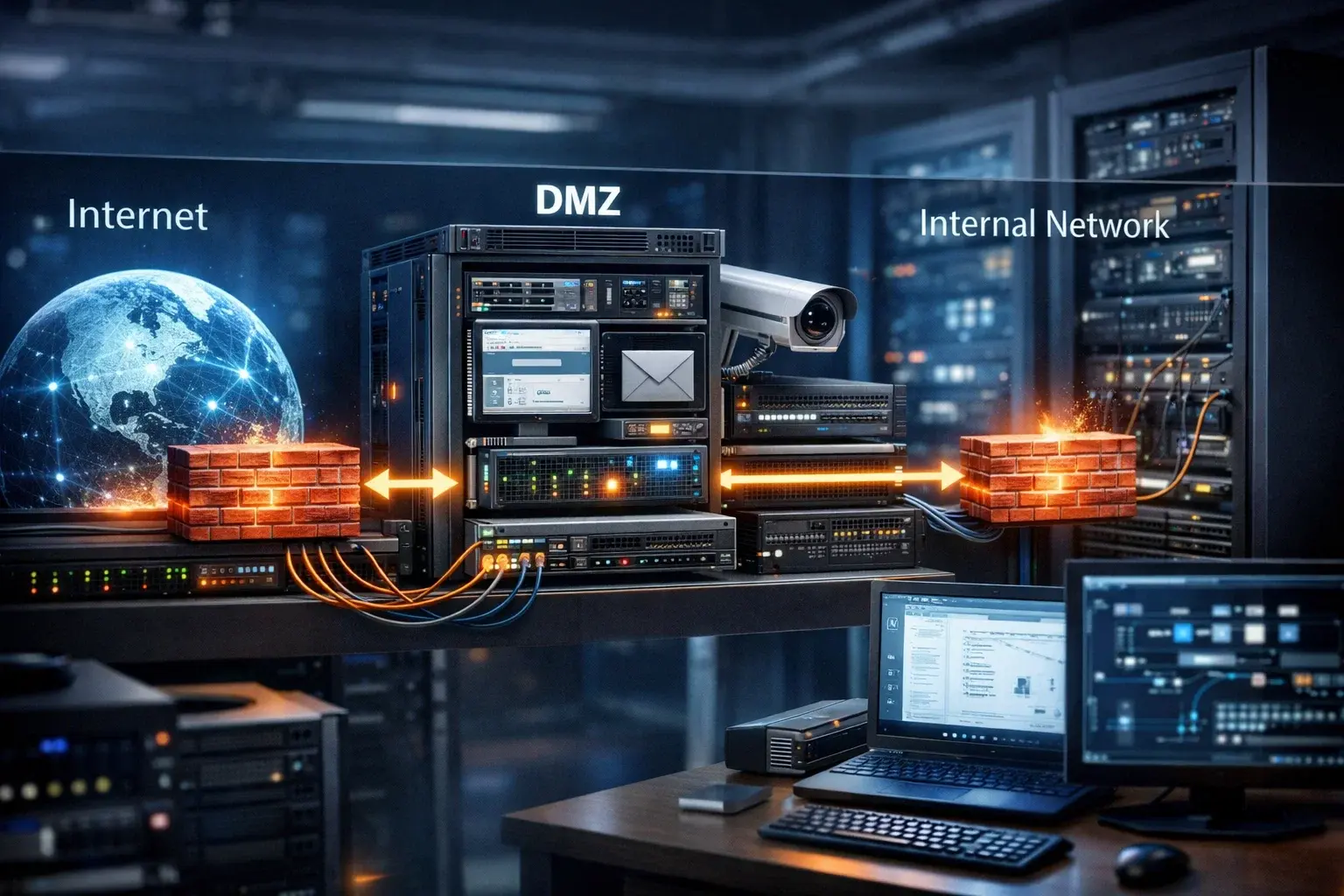
A DMZ (Demilitarized Zone) is an intermediate network segment located between an organization's internal network and the external network (Internet). Its function is to act as an isolation zone where services that must be accessible from the outside are placed, without directly exposing the internal network.
Simply put, the DMZ works like a "security buffer." If an attacker manages to compromise a server located in the DMZ, they will not have direct access to the critical systems of the internal network.
The concept of a DMZ comes from the military domain, where it describes a neutral zone between two territories. In networking, the idea is similar: separation and protection.
What Is a DMZ Used For?
The DMZ is primarily used to host services that need to be public or accessible from the Internet, such as:
-
Web servers
-
Mail servers
-
FTP servers
-
Public-facing corporate applications
-
Client or vendor portals
By placing these services in the DMZ, the risk of an external attack directly compromising the internal network is reduced—where sensitive data such as databases, financial systems, or confidential information typically reside.
How Does a DMZ Work?
A DMZ is typically implemented using one or more firewalls that control traffic between three main zones:
-
Internet (external network)
-
DMZ
-
Internal network
The firewall is configured with specific rules that allow only the necessary traffic to reach the services in the DMZ and strictly limit connections from the DMZ to the internal network.
For example:
-
The Internet can access the web server in the DMZ via port 443 (HTTPS).
-
The web server in the DMZ can communicate with an internal database only through a specific port.
-
No direct access from the Internet to the internal network is allowed.
In this way, the principle of least privilege is applied.
Read more: 5 Ways a Firewall Blocks a Ransomware Attack
Benefits of Implementing a DMZ
Implementing a DMZ as part of perimeter security offers multiple advantages:
-
Greater Protection for the Internal Network: The main benefit is isolation. Even if a DMZ server is attacked, the internal network remains protected.
-
Reduced Attack Surface: By exposing only strictly necessary services, vulnerable points are minimized.
-
Better Traffic Control: Firewall rules allow precise control over which communications are permitted and which are not.
-
Regulatory Compliance: Many security standards and regulations (such as ISO 27001 or PCI-DSS) recommend or require network segmentation, where the DMZ plays a key role.
DMZ Design and Architecture
A DMZ is not an “open” network without control, but rather an environment specifically designed to expose services securely. There are different approaches to its design and architecture, ranging from simpler setups to more robust and scalable schemes.
Today, most modern implementations favor dual-firewall architectures, as they offer higher levels of protection and flexibility.
-
Single Firewall DMZ: This model uses one firewall with interfaces for the Internet, the internal network, and the DMZ. Specific rules control which traffic reaches the DMZ and limit communication with the internal network. It's viable for small environments, though with a lower level of security.
-
Dual Firewall DMZ: This more secure architecture, common in medium and large companies, uses two firewalls: the first filters traffic from the Internet and only allows access to services in the DMZ, while the second strictly limits connections from the DMZ to the internal network. An attacker would need to breach both devices to reach the LAN, significantly increasing the difficulty of an attack.
Security can be further reinforced by additional segmentation and specific controls. For example, within the DMZ, IDS or IPS systems can be integrated and configured to only allow HTTPS traffic over port 443, blocking any unauthorized communication attempts. This approach reduces the attack surface and improves control over exposed services.
Importance of DMZ Networks
In modern environments—where local infrastructure, cloud, virtual machines, and containers coexist—the DMZ continues to play a vital role. Whether in hybrid scenarios with platforms like Microsoft Azure or in networks that integrate VPN, IoT, or Operational Technology (OT) systems, the DMZ serves as a segmentation layer that limits the impact of potential attacks and reduces the overall threat surface.
That said, the DMZ should not be seen as a standalone solution. It is part of a comprehensive cybersecurity strategy and must be complemented with continuous monitoring, threat detection systems, vulnerability management, update and patch policies, and user awareness programs.
Additionally, it's essential to regularly audit firewall rules and exposed services to avoid outdated or insecure configurations that could become weak points.
When Does a Business Need a DMZ?
If a business exposes services to the Internet, implementing a DMZ is highly recommended. This applies both to a small business with just a corporate website and to a large organization with multiple publicly accessible applications.
At TecnetOne, we understand that any external access point poses a risk if not properly secured. A DMZ helps isolate these public services, reducing the chances of a breach spreading to the internal network.
It’s especially useful when:
-
You handle sensitive data or critical information.
-
You offer online services to clients or suppliers.
-
You aim to comply with security standards and regulations.
-
You want to minimize the impact of potential attacks or incidents.
Conclusion
A DMZ is an essential component of a strong cybersecurity strategy. When properly implemented, it separates exposed services from the rest of the network, reducing the attack surface and improving access control.
While a DMZ is not a standalone solution that guarantees complete security, when combined with firewalls, continuous monitoring, and cybersecurity best practices (like those we promote at TecnetOne), it becomes an effective barrier against external threats.
Investing in a well-segmented network architecture not only protects your data, but also boosts customer trust, supports compliance efforts, and ensures operational continuity.