
When you read headlines about alleged data breaches at VPN services, it’s normal to feel alarmed. After all, you trust these platforms to protect your privacy, your connections, and a significant part of your digital life. That’s why the recent case in which NordVPN publicly denied a supposed cyberattack deserves a clear explanation—without panic, but with proper context.
At TecnetOne, we believe this type of news is a perfect opportunity to understand how security incidents really work, what a false positive is, and why not everything posted on hacker forums equals a real breach.
The Origin of the Controversy: A Leak Claimed on Underground Forums
The issue began when a threat actor using the alias “1011” posted a message over the weekend on a hacking forum, claiming to have accessed NordVPN’s development servers. According to the post, the attacker allegedly obtained more than ten databases containing sensitive information, including supposed Salesforce API keys and Jira tokens.
The actor claimed the access was achieved through a brute-force attack against a misconfigured server and that the data came directly from an internal NordVPN development environment.
As often happens in these cases, the claim spread quickly, raising doubts among users and generating alarming headlines across tech media.
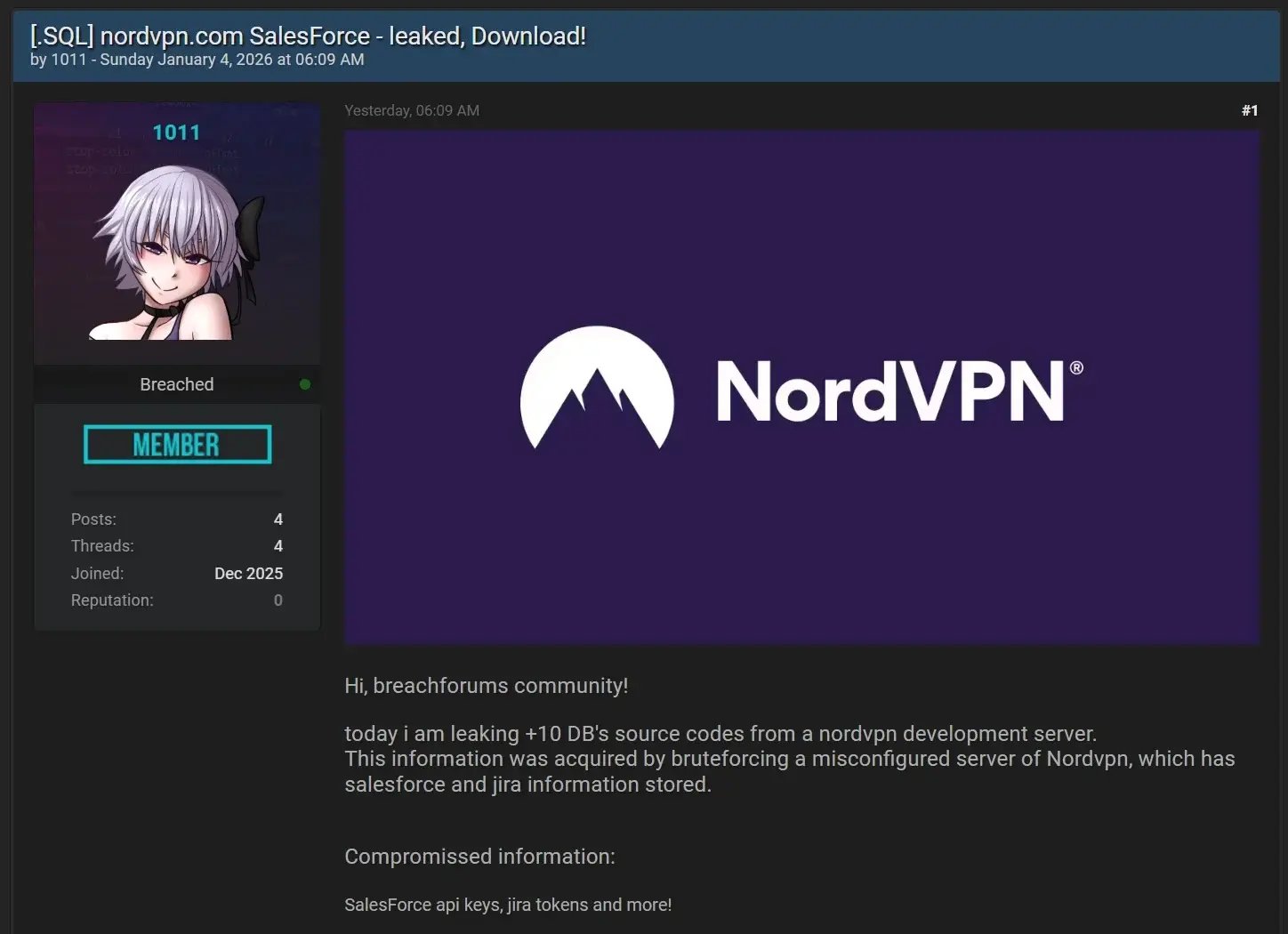
NordVPN breach claims (Source: BleepingComputer)
NordVPN’s Official Response: Dummy Data and an Isolated Environment
NordVPN responded quickly and firmly, denying that its internal or production systems had been compromised. According to the company’s official statement, the exposed information was not real data, but dummy data—fake information used exclusively for technical testing.
NordVPN explained that the data came from a temporary test account hosted on an external automated testing platform. This environment had been used months earlier to evaluate a potential vendor. Crucially, that environment:
- Was not connected to NordVPN’s real infrastructure
- Contained no customer data
- Included no production code
- Stored no active credentials
- Was never used in a live environment
In short, it was an isolated testing setup created solely to validate functionality and never became part of NordVPN’s operational systems.
What “Dummy Data” Is and Why It’s Used
To properly understand the situation, it’s important to clarify a key concept: dummy data. In software development and cybersecurity, it’s common to create test environments that simulate real databases without containing actual information.
Dummy data is used to:
- Verify integrations
- Test workflows
- Evaluate third-party vendors
- Validate database schemas
- Detect errors without real risk
Even if these datasets look “sensitive” at first glance—tables, field names, or API structures—they pose no real impact if they are not connected to production systems and contain no real data.
Why the Attacker May Have Thought It Was a Real Breach
From the outside, especially on underground forums, any database with technical-looking structures can be interpreted as a major leak. NordVPN noted that the exposed elements—such as API schemas or table structures—could only have originated from a test environment, which is standard during early technical evaluations.
Since the vendor being tested was ultimately not selected, the environment was abandoned and never integrated into NordVPN’s infrastructure.
Still, NordVPN confirmed that it contacted the external provider involved to gather additional information and fully review the situation—an approach consistent with responsible incident handling, even when the actual risk is minimal.
Learn more: Data-stealing Chrome Extensions Impersonate Fortinet, YouTube, VPNs
So Did Nothing Happen? Technically Yes, Strategically No
While there was no real breach in this case, the situation highlights several important lessons for both users and organizations:
- Test environments must also be protected
Even without real data, exposure can create reputational or media risks. - Attackers seek visibility
Posting alleged breaches on forums is a way to gain attention, even when the impact is limited. - Perception matters as much as technical reality
A false alarm can damage trust if not handled transparently.
At TecnetOne, we emphasize that cybersecurity is not only about technology—it’s also about communication, context, and reputational risk management.
The 2019 Precedent: Why Many Remember the Past
This is not the first incident associated with NordVPN’s name, which explains why the story gained so much traction. In 2019, the company confirmed that one of its servers—along with servers from other providers like TorGuard—had been compromised.
In that incident, attackers gained root access and obtained private keys used to secure web servers and VPN configurations. Although no user data was accessed and the impact was limited, the event marked a turning point.
How NordVPN Responded After the 2019 Incident
Following that breach, NordVPN significantly strengthened its security posture. Measures included:
- Launching a bug bounty program
- Conducting large-scale external security audits
- Hiring independent security experts
- Migrating to company-owned servers
- Eliminating physical hard drives
- Operating exclusively on RAM-only servers, which store no data after shutdown
These steps were designed to reduce the impact of any unauthorized access and improve resilience against future incidents.
Similar titles: The Hidden Danger of VPNs: What They Don't Tell You
What You Should Learn as a User
Even if you are not a NordVPN customer, this case offers practical takeaways for any digital user:
- Not all “leaks” are real
- Waiting for official statements matters
- Transparency is critical
- A company’s incident response history matters more than claiming zero issues
In cybersecurity, the real question is not whether incidents will occur, but how they are handled.
A Broader Lesson for Companies and Technology Providers
For organizations, this case reinforces several best practices:
- Fully isolate testing environments
- Assess the security of third-party vendors
- Remove unused temporary environments
- Monitor exposure—even of dummy data
- Prepare clear incident communication plans
At TecnetOne, this is exactly where we help: preventing, detecting, and clearly explaining incidents before they turn into full-blown crises.
Conclusion: Calm, Context, and a Security-First Culture
The alleged NordVPN breach ultimately turned out to be a false alarm—but it remains relevant. It shows how easily confusion spreads, how quickly accusations gain traction, and how critical solid response processes are.
Cybersecurity is not just about preventing attacks. It’s about separating noise from real risk, communicating clearly, and continuously improving defenses.
And that, ultimately, is the foundation of a mature security culture.
