
 InvisibleJS: When JavaScript Code Becomes Truly Invisible" loading="eager">
Imagine opening a JavaScript file in your trusted editor and seeing something puzzling: a completely blank file. No code, no comments, nothing. Yet, when executed, the program runs perfectly fine. It’s not magic—it’s InvisibleJS, a new tool that’s raising eyebrows in the cybersecurity community.
If you work in development, security, or are simply interested in how malware obfuscation techniques evolve, this case is worth your attention. At TecnetOne, we break down what InvisibleJS is, how it works, why it’s dangerous, and what it means for modern threat detection.
What Is InvisibleJS and Why Is It Making Waves?
InvisibleJS is an open-source tool hosted on GitHub that hides JavaScript code in files that appear completely blank. At a glance, there's nothing suspicious—no text, no visible symbols. But beneath the surface, the code is there.
The trick lies in using zero-width Unicode characters as a form of steganography. These characters are invisible on screen but remain part of the file’s content. InvisibleJS leverages this to embed executable instructions that escape the notice of both human eyes and many basic scanners.
While its creator presents it as a technical experiment, its abuse potential is obvious. And when a concealment method is this effective, cybercriminals don’t stay away for long.
How Code Is Hidden in “Empty” Files
InvisibleJS works through a clever yet unsettling process: converting regular JavaScript into a binary representation. Then:
- Each 0 becomes a Zero Width Space (U+200B)
- Each 1 becomes a Zero Width Non-Joiner (U+200C)
The result? A file that looks empty but secretly holds a complete sequence of encoded instructions.
When executed, a lightweight loader is used to:
- Read those invisible characters
- Reconstruct the original JavaScript code
- Execute it at runtime
All this happens without the user seeing anything strange—even in editors like VS Code.
Learn more: Identity Dark Matter: The Invisible Side of Digital Identity
Two Versions for Different JavaScript Environments
InvisibleJS includes two versions designed for different usage contexts, making it more flexible—and more dangerous.
Version 1: Classic Mode with eval
- Compatible with CommonJS
- Ideal for legacy Node.js setups
- Uses require and module.exports
- Synchronously runs code via eval
Version 2: Modern Mode with import
- Built for ES Modules (ESM)
- Uses dynamic import() and top-level await
- Requires .mjs files or "type": "module" in package.json
- Executes code asynchronously
In both cases, the result is the same: a visually empty file executing real logic without raising red flags.
Why This Technique Is Especially Dangerous
While JavaScript obfuscation isn’t new, InvisibleJS takes it to a whole new level:
- Total invisibility – no readable code to manually inspect
- Static detection challenges – many engines skip zero-width Unicode
- Ease of use – hiding code takes just one command
- Broad compatibility – works across old and modern environments
This makes it a perfect fit for stealth malware loaders, especially in Node.js apps or backend services.
Not Entirely New—But More Accessible Than Ever
Though InvisibleJS is novel as a packaged tool, the concept isn’t brand new. Since at least 2018, researchers have experimented with:
- Hiding instructions in clean-looking files
- Using Unicode to bypass security analysis
- Combining steganography with anti-debugging tricks
Some attacks even used scripts encoded in non-Latin alphabets like Hangul. What’s different now is accessibility—InvisibleJS makes this technique usable out of the box.
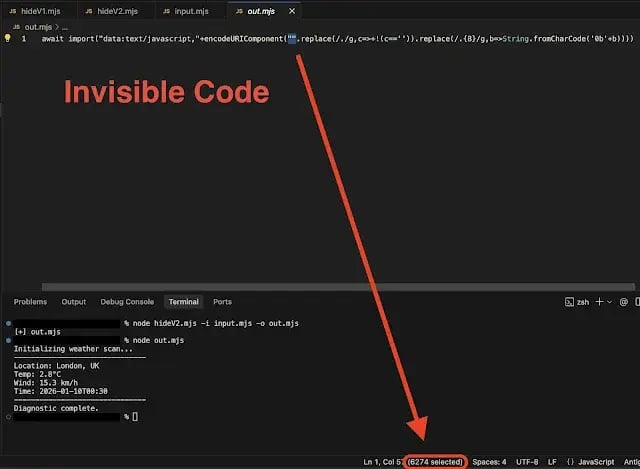
Invisible Code (Source: Cybersecurity News)
Real Risks in Malware and Phishing Campaigns
From a defensive standpoint, InvisibleJS opens up several serious threat vectors:
- Malicious scripts hidden in open-source packages
- “Empty” dependencies executing stealth logic
- Invisible loaders in web apps and APIs
- Harder forensic analysis after incidents
In phishing, attackers could distribute clean-looking .js files that steal credentials, drop malware, or open backdoors.
Similar titles: AI Use in Companies Is Invisible to Security Teams
What This Means for Security Teams
Tools like InvisibleJS send a clear signal: traditional defenses aren’t enough. It’s no longer safe to assume visible = secure.
To mitigate the threat, security teams must:
- Implement Unicode-aware scanners
- Use behavioral detection alongside static analysis
- Audit “empty” scripts and dependencies
- Train developers and analysts in modern obfuscation tactics
At TecnetOne, we emphasize this constantly: signature-based detection isn’t sufficient. Context and behavior are increasingly essential.
The Dual-Use Dilemma in Cybersecurity
InvisibleJS embodies a recurring challenge in the cybersecurity world: many innovations have both legitimate and malicious use cases. Steganography can protect intellectual property—or hide malware.
The problem isn’t the tool—it’s the intent. But from a security perspective, ignoring such tools just because they’re “experimental” is not an option.
Conclusion: A Glimpse Into the Future of Threats
InvisibleJS isn’t just a clever curiosity. It’s a warning sign of where threat concealment is headed: more stealth, less visibility, better evasion.
Today it’s JavaScript with invisible characters. Tomorrow it could be another language, another file type, another method.
At TecnetOne, we believe the only viable defense is anticipation. Understanding tools like InvisibleJS now puts you one step ahead of the threats of tomorrow—because while code can be invisible, your vigilance can’t afford to be.