Most security teams already know where their gaps are. The hard part is deciding which one to tackle first, and that decision shapes how much ground the team actually covers in any given week.
They know there are devices without an agent, unpatched vulnerabilities and accounts nobody has touched in months. But opening the portal on a Monday with limited time always leaves the same question open: where do we start?
When that question has no clear answer, one of two things usually happens. Either the team handles whatever is loudest instead of whatever is most dangerous, or everything sits in a backlog that ages until it becomes a risk of its own.
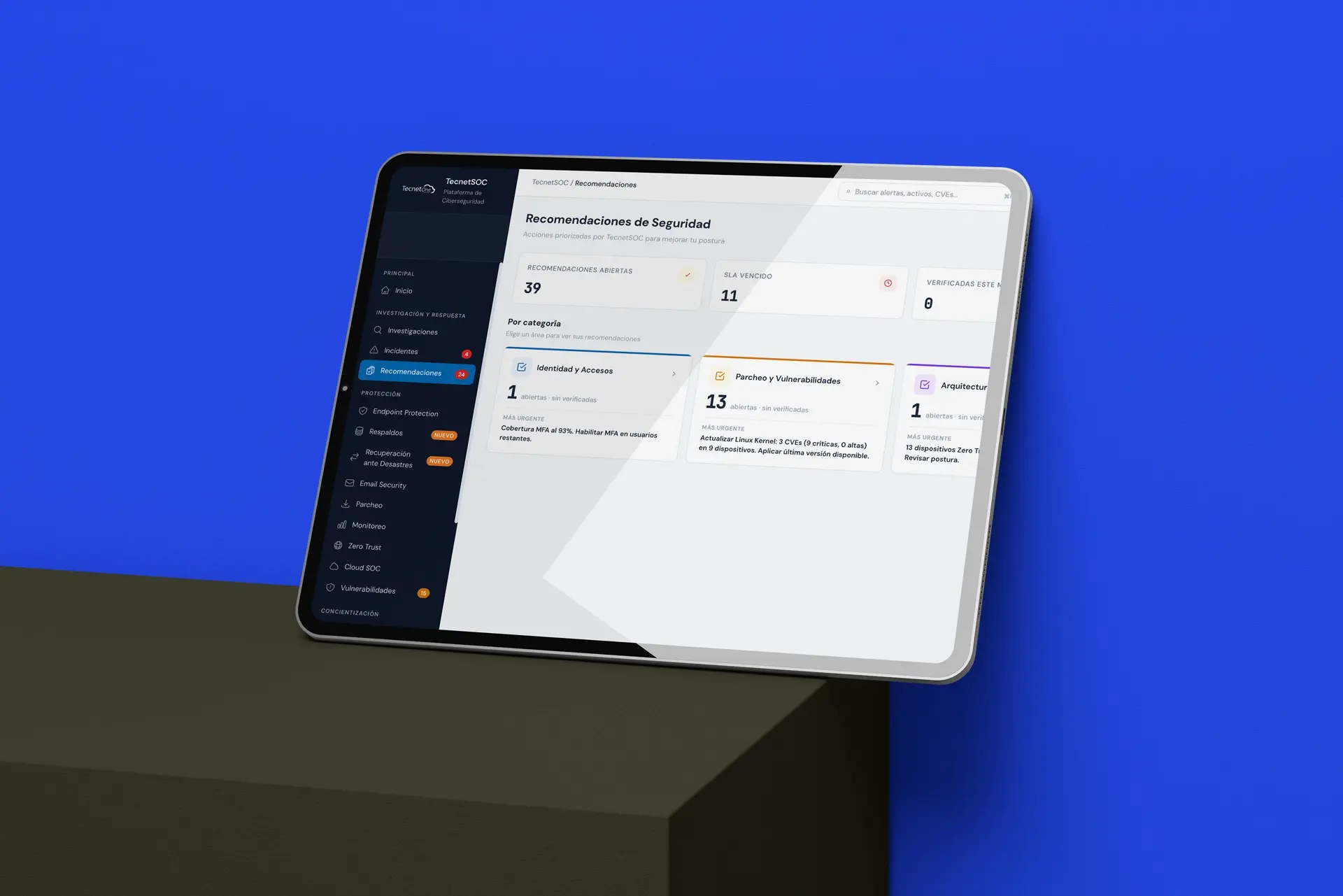
That operational friction is exactly what the Recommendation Engine in TecnetSOC is built to remove. It is now available to every customer and continuously reviews the devices and users in your organization, finding the real gaps in your security posture and ranking them by impact instead of by age.
Seeing the gaps was never the problem. Choosing the first one was
When telemetry arrives from every direction at once (asset inventory, SIEM status, vulnerability scans, identity, Zero Trust), the list of issues grows faster than any team can work through it. That is where the trap begins.
A device without a SIEM agent (security information and event management, the system that collects and analyzes security logs) and an inactive account can show up in the same shade of red on a flat dashboard. Their real exposure, however, is completely different.
Without a layer that weighs impact, prioritization depends on the gut feeling of whoever is on shift. Gut feeling does not scale, and it cannot be audited.
Teams know this. That is why many operations end up organized around perceived urgency instead of real risk: whatever turns red first gets attention, even when something else would hurt more if it broke.
There is also a second cost, quieter but just as expensive: the manual correlation work required before anyone can even decide. Matching who has MFA against which devices report to the SIEM against which vulnerabilities are still open eats up hours and is almost never documented.
Every one of those hours is an hour not spent closing the gap. For a CISO or an IT director, that cost adds up quickly. According to the IBM Cost of a Data Breach Report 2025, the global average breach lifecycle (from identification to containment) is 241 days, a window in which late prioritization weighs as much as detection itself.
How the Recommendation Engine works
The engine continuously generates recommendations from the telemetry TecnetSOC already collects. There is no scan to launch and wait on: it is an ongoing process that reviews your posture periodically and reassesses it as new data comes in.
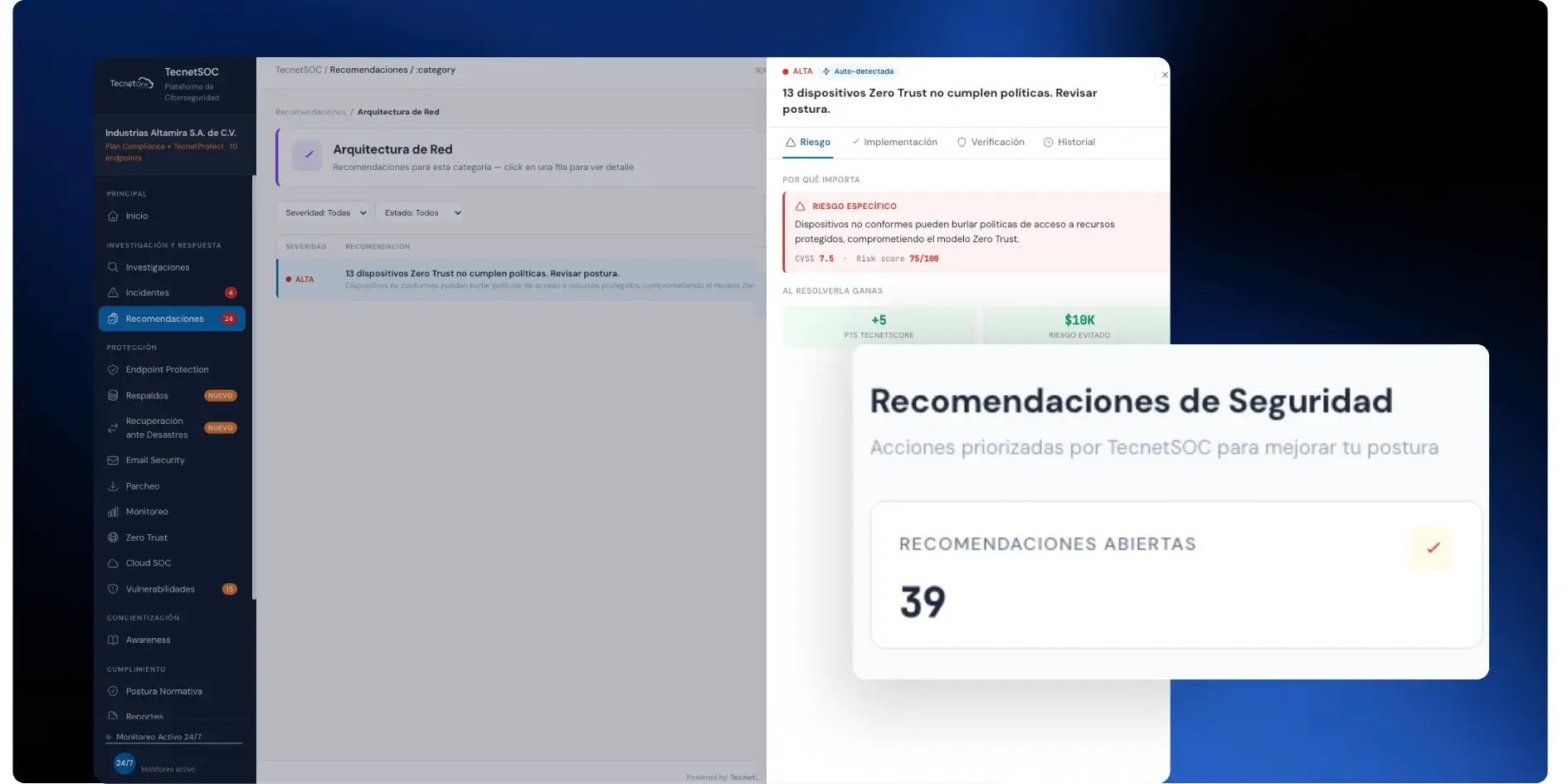
Each finding is weighted by its potential impact and placed in a prioritized queue. The first item you see at the top is the one that matters most to your risk level.
The five gap families it covers today
The engine covers five families of gaps. These are the areas where security posture breaks down most often in practice, so ranking them by risk gives the biggest operational return.
It identifies devices without a SIEM agent installed, the blind spots where you have no security visibility. It finds devices with open vulnerabilities waiting for a patch, where the exposure is already known and only needs to be closed.
It flags users without MFA (multi-factor authentication) enforced on platforms such as Microsoft Entra ID. Those accounts are still one of the most exploited ways in, and one of the cheapest to close.
It points out Zero Trust verification failures, when an access attempt does not meet the conditions it should. And it detects inactive accounts with no recent sign-in: forgotten credentials that add nothing to operations but widen the attack surface.
Who detects, who approves (and what it does not automate yet)
What really changes the daily routine is what happens after detection. Every recommendation comes with an approval workflow: TecnetOne proposes the action and supports it, and your team reviews and approves it before anything is executed.
TecnetOne handles the continuous generation of recommendations, the prioritization by impact and the guidance during remediation. The customer keeps the decision: reviewing the proposals and working on the prioritized gaps according to its own context.
It is worth being clear about one limit, because that transparency is part of the product. The engine works within a defined scope and does not run automatic remediation without approval. SOAR-style automatic closure (security orchestration, automation and response) is on the roadmap, but for now no corrective action happens until someone on your side says yes.
For most teams that is an advantage. It keeps control of the decision where it belongs while the engine does the heavy lifting of finding and ranking.
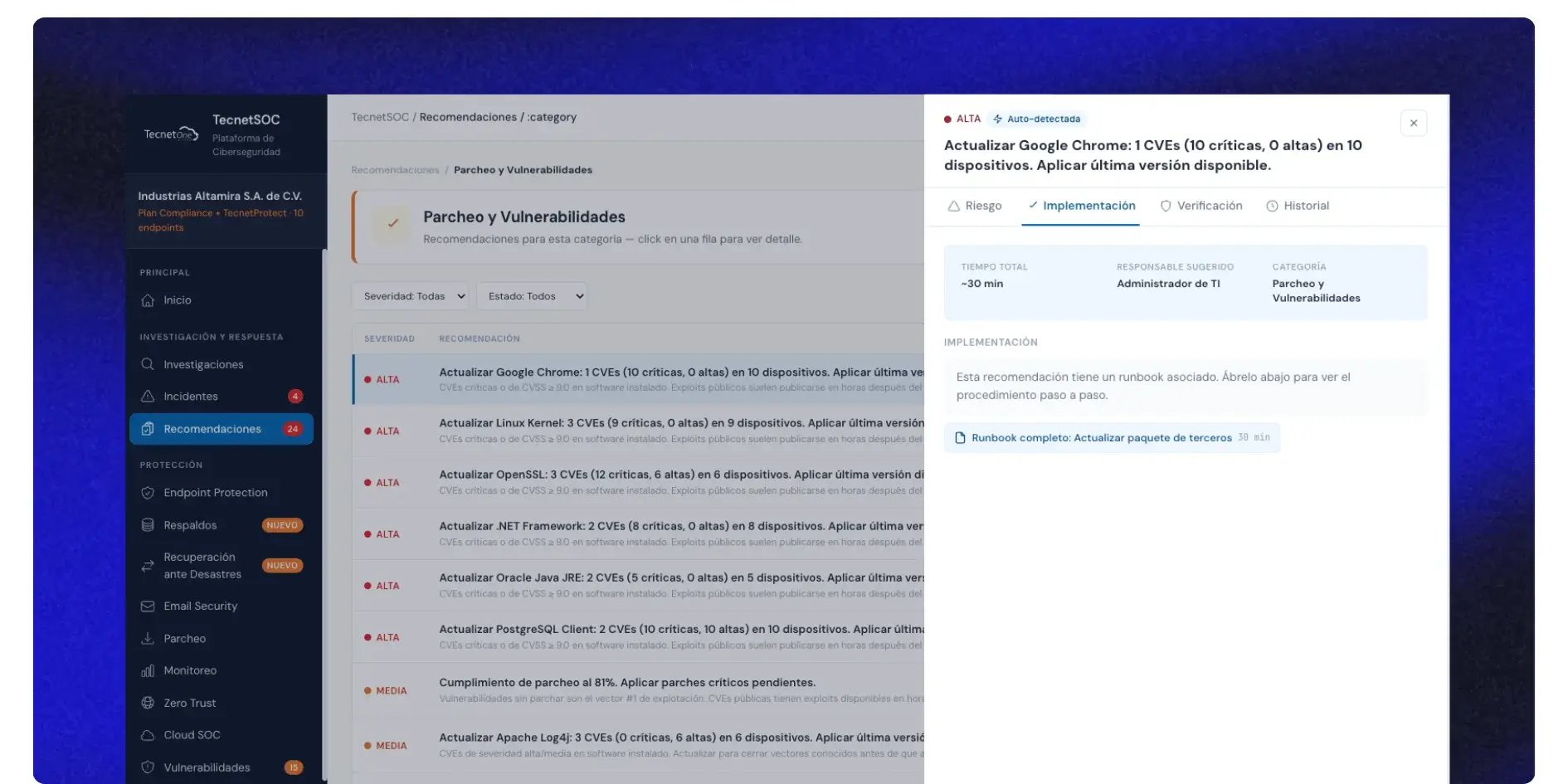
The operational impact: from a flat list to a queue with clear criteria
What you get in the end is a different way to start the day. Instead of a flat dashboard where everything competes for your attention, you open a queue where the first item is the one that lowers your risk the most once it is resolved.
The engine takes over the tedious part of cross-checking identity, SIEM and vulnerability signals to decide what matters most. That correlation work is exactly what slows down the step from seeing a gap to doing something about it.
With that out of the way, the team spends its time remediating instead of debating where to start. It is a natural way to put risk-based vulnerability management into practice without building it by hand.
There is also a benefit that shows up when an audit comes around. Because every recommendation starts from telemetry and goes through an explicit approval workflow, you keep a clear chain of what was detected, what was proposed and who approved the action.
Prioritization stops being an opinion you can only defend verbally and becomes a process with repeatable criteria and a paper trail. That traceability reduces friction during an external review and gives concrete support to the frameworks where TecnetSOC helps with compliance, such as ISO 27001 or PCI DSS.
Checklist: five gaps to review this week
If you are not ready yet to turn on an engine that ranks them for you, you can still do a first manual sweep of the five families that are the most worthwhile to close today.
Think of it as a warm-up for the conversation. It gives you a sensible starting point, especially if your company operates in a regulated industry where evidence of control matters as much as the protection itself.
- Review devices without a SIEM agent. Any endpoint (a laptop, desktop or server) without an agent is a blind spot: what you cannot see, you cannot prioritize.
- Audit open vulnerabilities by age. The ones that have gone unpatched the longest are the most likely to be exploited.
- Check MFA coverage user by user. An active policy does not guarantee that every user actually complies with it.
- Review access attempts that fail Zero Trust verification. Each failure points to an inconsistent configuration or a real attempt.
- List inactive accounts with no sign-in for more than 60 days. Unused accounts add nothing to operations and widen your attack surface.
How to get started with the Recommendation Engine
If you already use TecnetSOC, the engine is already running on your telemetry. The next time you log in to the portal, check the prioritized queue: the order of the findings answers the hardest question of any Monday morning, where to start.
TecnetSOC runs on the sources you already have deployed, with no new installations or technical reconfiguration. What changes is the daily routine: you move from a flat dashboard to a queue prioritized by risk, with evidence of control your team can show any auditor without building it by hand.
If you would like to see the Recommendation Engine running on your own infrastructure or understand what results it can deliver for your security team, schedule a conversation with our sales team. If you are already a TecnetSOC customer, reach out to your account manager to review the engine's scope under your current plan.