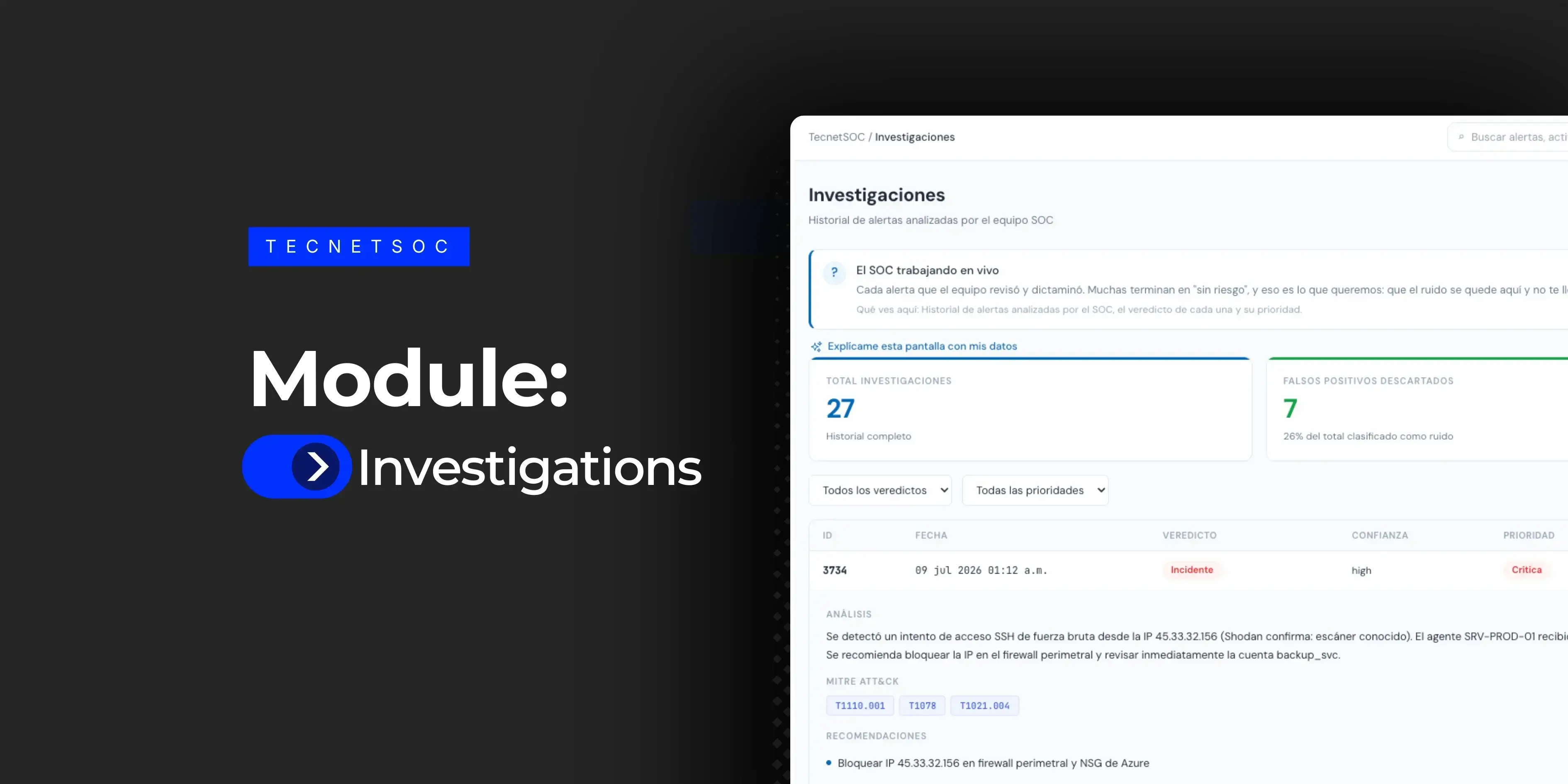
Before an alert becomes a confirmed incident, an AI agent analyzes it first and decides whether it deserves escalation to a human analyst. The TecnetSOC Investigations module is the piece that makes that call: it reviews every incoming alert, classifies it with the MITRE ATT&CK framework and decides whether it escalates to a real incident or gets dismissed as a false positive, all with a traceable history the customer can check at any time.
It is the step that happens before what you already know from the TecnetSOC Incidents module: while Incidents manages the lifecycle of what has already been confirmed, the Investigations module decides what deserves to get that far.
Without that filter, any security team ends up treating every alert as if it were serious, and that wears down both the analyst and the customer. TecnetSOC takes on that load: it reviews and dismisses whatever is not a threat, and only brings to the customer what truly requires their decision.
The real problem is what happens before an alert is confirmed
Monitoring systems generate alerts all the time, and most of them are not real threats. Detecting those events is the easy part. The hard part is analyzing them with sound judgment before deciding what to do with each one. When that analysis is not documented, the company lives with constant uncertainty: it does not know how many alerts were reviewed, how many were noise and how many actually called for a response.
That lack of traceability also makes any conversation with a customer or an auditor harder. Saying "we checked it and it was nothing" is a long way from showing the full analysis, with the threat classification and the reasoning that led to dismissing it. The Investigations module exists to close the gap between what was done and what can be proven.
How the TecnetSOC Investigations module works
MITRE ATT&CK classification: the reasoning behind every investigation
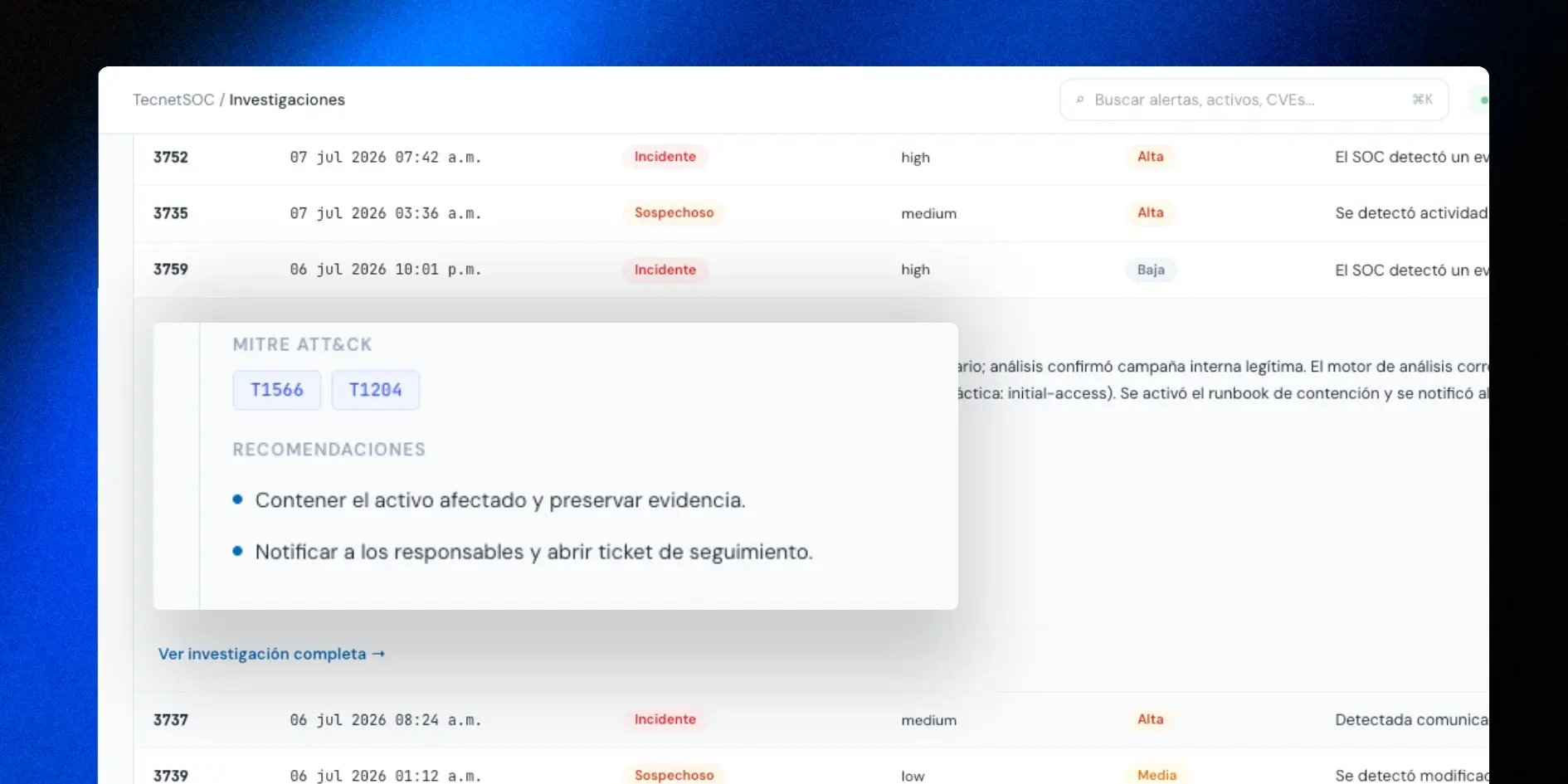
Every alert that enters investigation is analyzed and classified using MITRE ATT&CK (the industry's most widely used reference framework of attack tactics and techniques). This gives each investigation clear context: beyond knowing whether something is a threat, you understand which kind of adversary behavior it relates to and why.
Honest metrics: total, false positives and confirmed
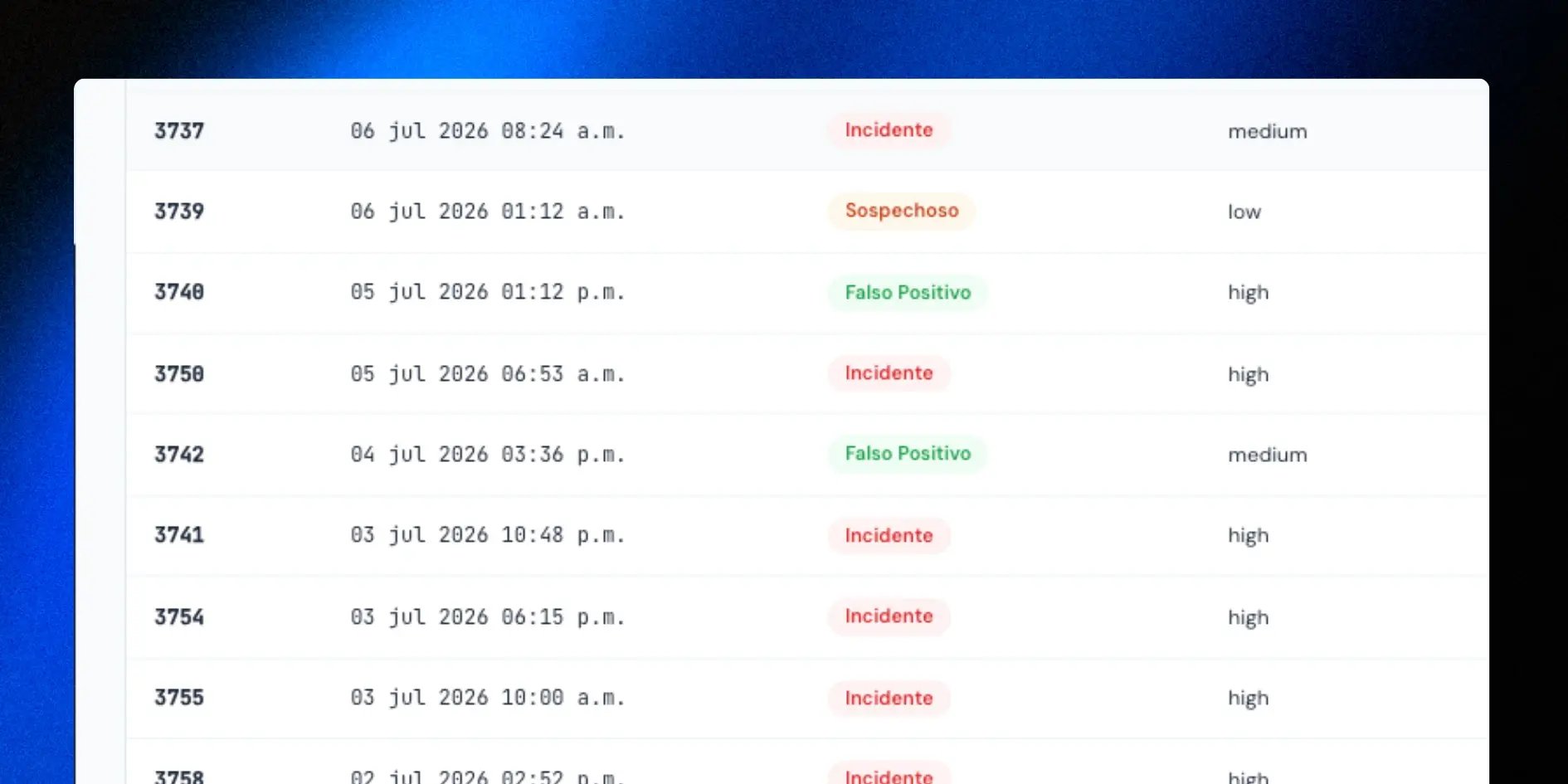
The module shows real figures for the full set of investigations, including those beyond the page the customer happens to be viewing. You can see how many alerts were analyzed, how many were dismissed as false positives and how many ended up confirmed as incidents.
That transparency prevents the blind spots many security teams create without realizing it. On the customer side, the only requirements are keeping the TecnetSOC agent active and reporting telemetry, and approving in advance the automated response playbooks that TecnetSOC can run on their behalf.
A living case file: direct communication with TecnetSOC
Each investigation is documented as a case file the customer can open, comment on and follow without leaving the portal. From there they can ask the TecnetSOC team about the case directly, confirm they received the analysis or request a review if something does not add up. Notifications work both ways: when the team replies, the customer is notified, and when the customer comments, the analyst is notified. The specialist always appears as TecnetSOC, to protect the privacy of the internal team.
The operational impact: from scattered alerts to a traceable case file
The difference between investigating with this structure and doing it by hand shows up the moment someone asks why an alert was dismissed. When every investigation has its MITRE classification, its outcome and its full history, the answer already exists and nobody has to rebuild it from memory.
For day-to-day operations, this means less time explaining past decisions and more time analyzing what keeps coming in. For leadership, it means being able to show with real data how many alerts were processed and how they were filtered, which is directly useful during a security audit or when building the evidence a security operations center produces for frameworks such as ISO 27001 or PCI DSS.
That same investigative discipline is also the foundation of a good incident response plan, because you cannot respond well to something that was never analyzed in depth.
Checklist: five questions about your security investigations
- You know how many alerts were investigated at your company last month without having to ask anyone.
- You can tell from data how many of those alerts were false positives and how many were real threats.
- Every dismissed alert has a documented reason, beyond the word of whoever reviewed it.
- You know which attack tactic or technique the last confirmed threat at your company was linked to.
- Your team and your security provider see the same case file for each case, without relying on scattered emails.
This way of working is built into TecnetSOC, alongside incident management, continuous monitoring and the rest of its modules.
How to get started with the Investigations module
If you are already a TecnetSOC customer, the Investigations module is available in your portal: there you can review every analyzed alert, its MITRE classification and its outcome, and comment directly with the TecnetSOC team whenever you need more context on a case.
If you are not a customer yet and wonder how many alerts your operation lets through without documented analysis, it is worth booking a 30-minute session with a TecnetOne specialist. It is an initial assessment of how you investigate alerts today and what changes once that process is traceable and backed by a framework like MITRE ATT&CK.

Zoilijee is Founder and KAM of TecnetOne, she specializes in business development for Cloud, Hybrid and Enterprise Cyber Resilience environments, her main vision is to empower and protect organizations on new emerging threats in IT.